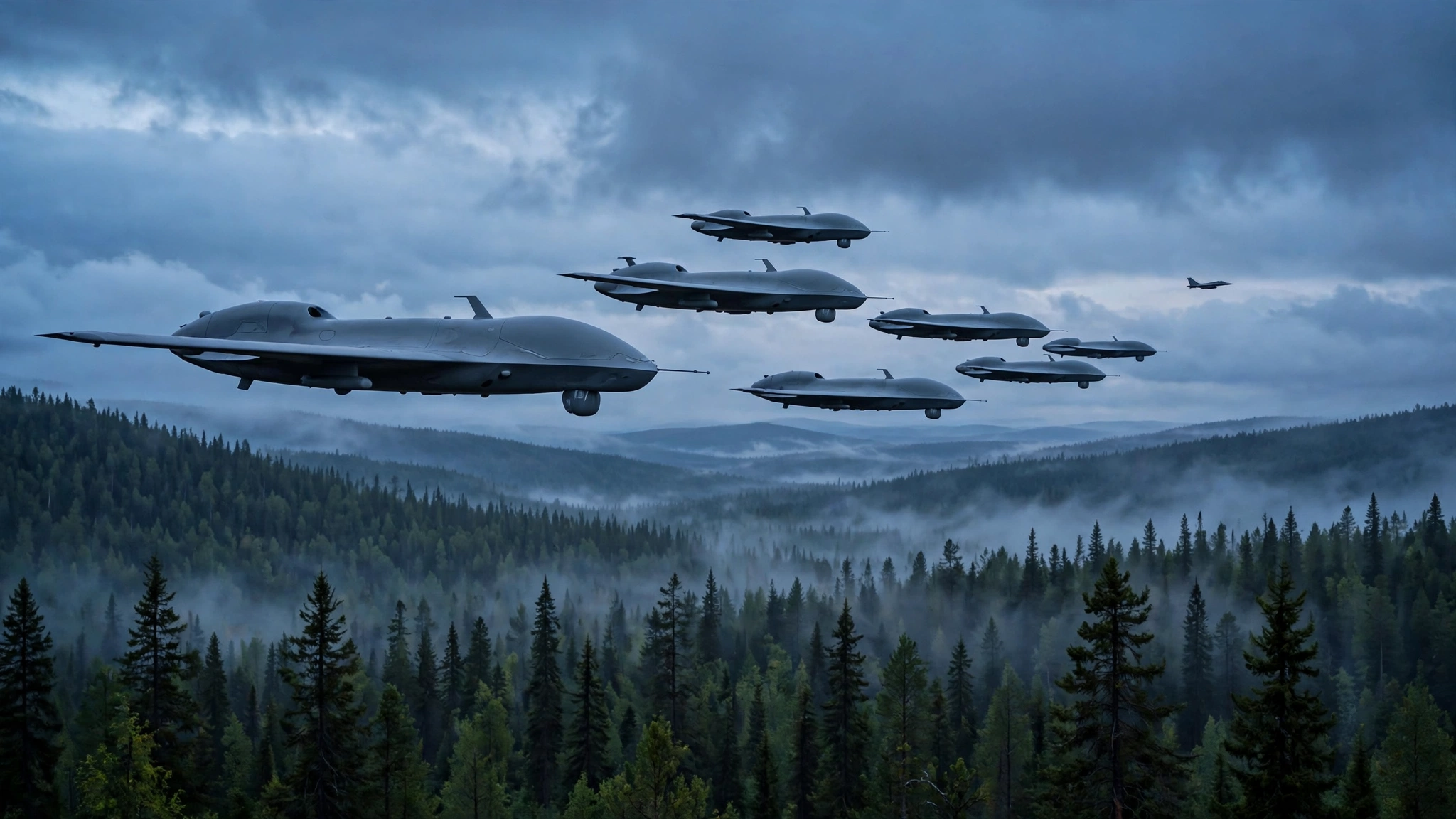
Canada is putting serious money behind AI-powered drone warfare. The federal government's Budget 2026, tabled on Thursday, proposes $2.3 billion over five years for the Defence Drone Initiative — a programme to accelerate the development, purchase and deployment of uncrewed systems and counter-drone defences. The funding, which would begin in the 2027–28 fiscal year, lands days after a CBC report asked a question Ottawa has so far avoided answering: is Canada ready for the age of AI warfare?
The answer, for now, is a cautious maybe. The Royal Canadian Air Force is examining how collaborative combat aircraft — uncrewed jets designed to fly alongside crewed fighters — could serve Canada, the Department of National Defence told CBC. But no decision has been made to buy any. Canada owns no collaborative combat aircraft today.
Robot wingmen, still on the drawing board
The idea is no longer science fiction. In July, American defence company Anduril's YFQ-44A drone, known as Fury, fired an air-to-air missile at a simulated target over California's Mojave Desert. In October, a pilot in an F-22 fighter jet directed the drone through simulated combat tasks. The aircraft is designed to fly ahead of a crewed fighter, beyond the edge of its radar, and strike on command.
A Canadian company wants in. Dominion Dynamics, a domestic defence technology firm, is building Scout, a collaborative combat aircraft that would fly three or four drones ahead of each crewed jet and be able to fire a weapon. Its chief executive, Eliot Pence, told CBC the aircraft would operate beyond the radar's edge — a role human pilots cannot safely fill alone.
The Royal Canadian Air Force took delivery of its first two F-35A fighter jets on October 22, giving it the crewed aircraft such drones would eventually accompany.
A $2.3 billion bet, starting in 2027
The money is moving faster than the procurement decisions. The Defence Drone Initiative was launched on July 23, 2026, and in September the government awarded initial contracts worth up to $50 million, aiming to increase the number of drones deployed by the Canadian Armed Forces tenfold. A marketplace launched the same month now lists nearly 400 Canadian suppliers of uncrewed technology, modelled on Ukraine's Brave1 cluster.
Prime Minister Mark Carney has also announced plans to build production capacity to manufacture millions of drones within two years, and Canada has committed to transferring a third of the drones it produces to Ukraine. The budget's $2.3 billion would fund reconnaissance and strike drones, autonomous platforms, low-cost interceptors and long-range precision-strike technology.
Humans stay in charge
Canadian officials drew a firm line on one point: warfare must remain a fundamentally human endeavour. The armed forces support autonomous functionality only when it operates within a responsible chain of human command and control, the defence department said, and no machine, weapons system or line of code can be held responsible for complying with international humanitarian law.
Canada voted yes to a 2025 United Nations resolution calling on countries to lay the groundwork for negotiations on a treaty governing lethal autonomous weapons. The budget's drone funding, and the air force's study of robot wingmen, will test how far that principle stretches as the technology — and the pressure to adopt it — accelerates.