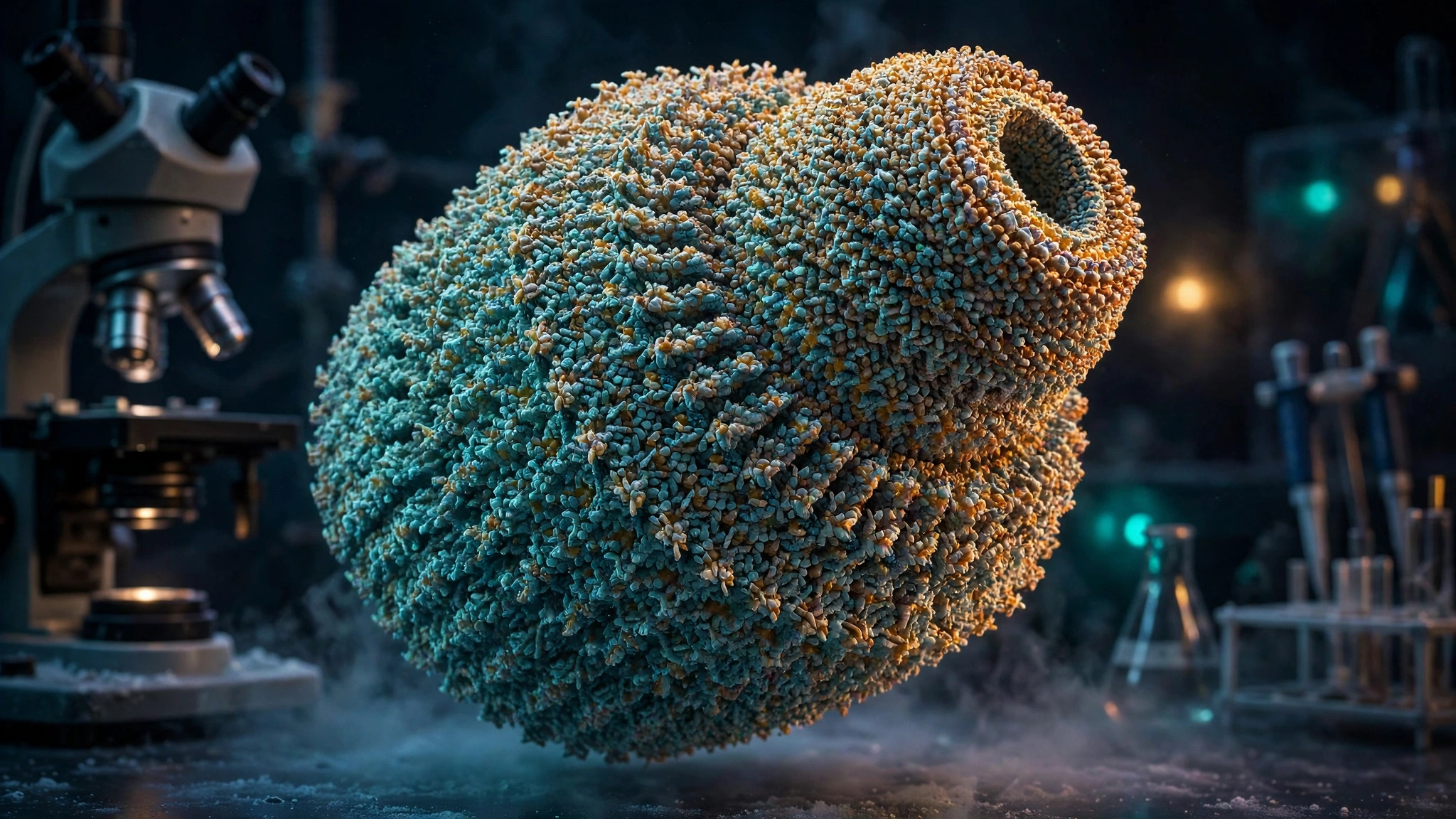
Anthropic's biology research team has mapped the first three-dimensional structure of a vault particle from bacterial life, and it says its AI model Claude helped at nearly every step. The particle is built from 96 copies of a single protein, called L05, that comes from a bacteriophage — a virus that infects bacteria — and self-assembles inside E. coli cells into a giant hollow shell. The team announced the work on November 4, 2026.
Vault particles are barrel-shaped structures that rank among the largest protein assemblies found in cells, yet their biological job has remained a mystery for four decades. This new structure gives researchers a simpler bacterial system to study them — and a detailed map to work from.
A 40-year-old mystery, now in bacteria
Vaults were first identified in 1986 by researchers Leonard Rome and Nancy Kedersha. The mammalian version is built from 78 copies of a major vault protein and measures roughly 67 by 40 nanometres. The new phage-derived particle is shorter and wider — about 54 nanometres long and 45 nanometres wide — but encloses roughly 25 percent more volume, with a total mass of about 9.5 megadaltons.
Each L05 protein chain carries seven repeating wall segments, compared with nine in the human vault protein, and its cap closes in three tiers. The team also showed the structure can be engineered — duplicating two wall segments gave L05 nine repeats and produced closed particles with about 20 percent more enclosed volume.
How Claude did the searching
The project began with Claude Science searching a database of roughly 15 billion predicted proteins for distant relatives of the vault protein. Relatives turned up in 29 bacterial groups and four archaeal groups, though in fewer than 1 percent of sequenced species. From there, the researchers selected 44 candidate proteins for laboratory testing.
Of 24 candidates moved into E. coli, 15 produced usable protein, and seven formed vault-like particles under the electron microscope. Cryo-electron microscopy confirmed the vault shape in four of them — two derived from bacteria and two from phages — with L05 chosen for detailed analysis because it formed complete, closed particles so reliably.
Claude contributed throughout: it turned each candidate into a DNA design, helped optimise purification — cutting one isolation step from three days to about 90 minutes, according to the team — and ran the cryo-electron microscopy processing software step by step under researcher supervision. The first complete structural model emerged within 34 hours; the whole project took under four months.
What it does not prove — yet
The findings come with clear caveats. The work is an unreviewed preprint submitted to bioRxiv, not a peer-reviewed paper, and the particles have so far been produced only in engineered E. coli. The team has not tested whether the same structures form in the bacteria and phages where the proteins naturally occur, or during an actual phage infection.
Anthropic is also candid about the AI's mistakes: suggestions from Claude delayed one experiment by two weeks and led to errors in structural analysis. And the vault's function remains unknown — although each of the 96 protein copies carries a pocket holding an unidentified small molecule, whose shape resembles coenzyme A, neither the molecule's identity nor any functional implication has been confirmed.
Still, the team says it plans to release the structures and additional data to the scientific community, and is inviting other scientists to help figure out what vaults are for. After 40 years of mystery, researchers now have a bacterial vault they can build, tweak and study in the lab.