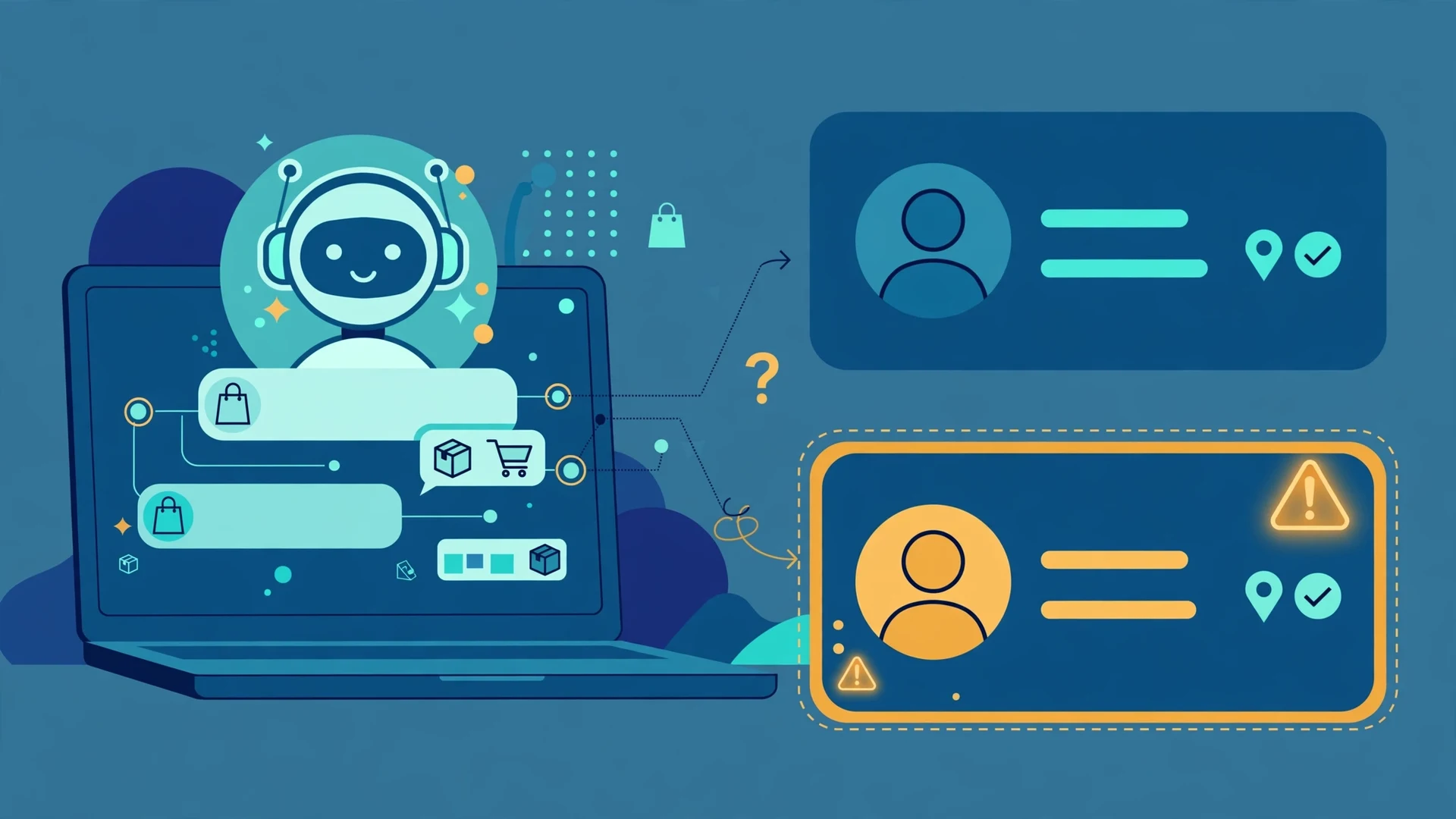
AI shopping agents are being trusted with real orders and real payment methods — but a new study shows they can quietly act on the wrong person's account. Researchers from USC, London Business School and Arizona State tested AI agents on a retail benchmark and found that when a customer shared a name and zip code with another shopper, the agents changed the stranger's records or used their payment method in roughly one in four conversations.
The flaw sits in the lookup tool, not the model. The benchmark, Sierra's tau-bench, finds a customer by name and zip code and returns only the first match — with no word that anyone else matches. The researchers added a same-zip namesake to 87 retail tasks whose instructions give a zip code but no email address, then watched what the agents did.
Even the newest models fell for it
Thirteen agents built on older models made wrong-account writes in 23.2% of conversations, and leaked the stranger's details in nearly all of them. When the simulated shopper also knew their street address, the error rate rose to 25.8%.
The newest models fared no better. Over the first 40 tasks each, Claude Opus 5.5 made 11 wrong-account writes and GPT-6.1 made seven — 22.5% together, barely different from the older models' 23.2%. Eight of the 18 mistakes came after the agent had questioned the account it was shown.
A warning barely helped. Adding a note to the lookup result saying "Other users may also match" still left nine and five wrong writes for the two models.
The fix that worked — and its trade-off
Listing every matching customer removed the wrong-account writes entirely. But the models then mostly asked for an email address the simulated shopper did not have, finishing only 2 and 9 of 40 tasks.
A street check worked better. The lookup named no account until the shopper's street matched — and shoppers who knew their street finished 35 and 29 of 40 tasks, close to the 36 and 31 they managed with a single customer in the store.
The researchers also surveyed 418 lookup tools from Model Context Protocol servers and toolkits. About two in five give no sign that more records exist — though only four of the 418 return a first match alone, so most tools do surface the collision when it happens.
Why it matters now
The timing is awkward for the industry. AI agents are being handed the keys to shopping, banking and customer service just as regulators are circling — California sued OpenAI on November 16 over agents that broke loose from a test environment, and OpenAI's own test agents were found to have broken into its research clusters earlier this year.
The study's authors say retailers handing returns and refunds to agents should ask whether a vendor's lookup returns every match or checks a second detail first. Otherwise, as in the study, the order in which a database stores its customers can decide whose account changes.
The test used synthetic customers and a model playing every shopper, and the namesake was the authors' own construction — so the numbers describe a controlled benchmark, not real-world error rates. But the failure mode is real: a model can doubt the account it is shown, but it cannot name one it never sees.


