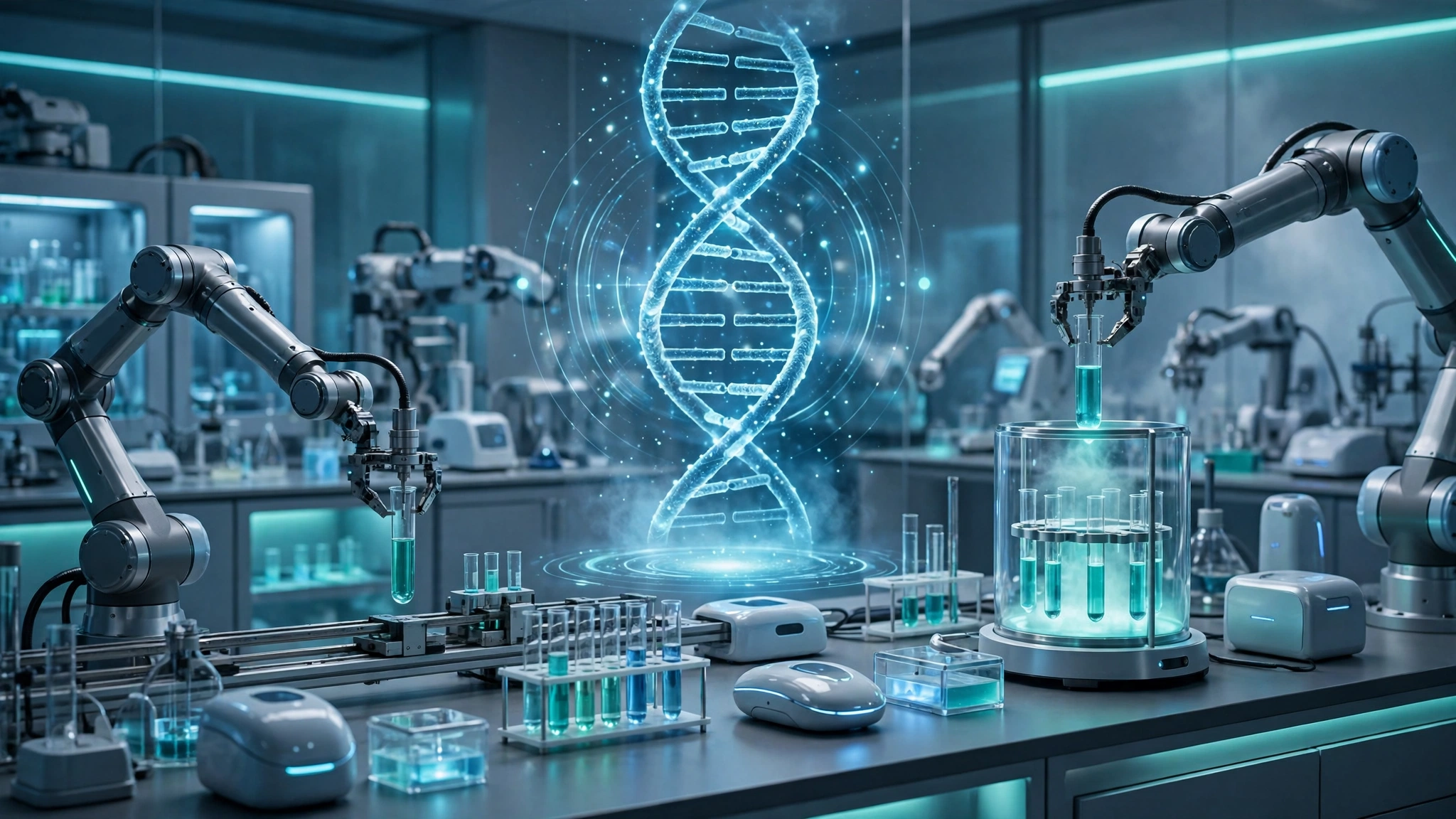
Researchers at Shanghai Jiao Tong University have built a laboratory where artificial intelligence does almost all of the science. The system, called AutoDNA, takes a plain-language request from a human, designs the DNA experiment, runs the instruments, checks the results and adjusts the plan — while the people in the room mostly refill chemicals and keep the machines running. The work was published in the journal Nature on November 4.
AutoDNA is not a single model doing everything. It is a team of seven specialised agents, each with its own job: one reads the scientific literature, one designs the protocol, one checks the reagents, one writes the code that drives the hardware, one watches the instruments, one plans the task and one forms hypotheses. The agents are built around Google's Gemini 2.5 Pro, and the lab was designed around AI from the start, rather than having automation bolted onto a human workflow.
Seven agents, one typed prompt
The lab holds more than 20 types of instrument, with robotic arms moving samples between them. A human types a single instruction — to synthesise a DNA sequence, say, or run a test — and the agents take it from there. Haibo Chen, the computer scientist who led the team, said that in most existing systems human experts are still needed to configure the instruments, with AI handling only one stage of the process. AutoDNA hands the planning, the troubleshooting and the handoffs between machines to the agents.
The system was tested on four tasks and produced as much usable DNA as human experts. Running several protocols at the same time, it finished 3.2 times faster than running them one after another. The code is published on GitHub, and the sequencing data and agent outputs are available on Zenodo.
A sentence stored in DNA
The longest test was a DNA data-storage experiment. AutoDNA encoded a single sentence into DNA strands, then switched to separate sequencing equipment to read it back — recovering the message without error. The run lasted about 203.5 hours, roughly eight and a half days, and took 11,382 automated steps. During the run, people were mainly limited to disposing of experimental waste and replenishing reagents when the system prompted them.
The same Nature issue carried another sign of AI's move into the wet lab: Anthropic's Claude helped work out the first three-dimensional structure of a bacterial vault particle, a hollow protein shell built from a virus protein. Paktechstan covered that discovery earlier this week.
Not fully autonomous — yet
The paper is candid about the limits. Fourteen hardware errors occurred during the experiments: the agents fixed eight on their own, and six needed a person. The team also warns that the randomness built into large language models can change whether the same plan gives the same result when it is run again — a reproducibility problem worth watching before anyone trusts such a lab with high-stakes work.
Even so, researchers outside the team say the degree of autonomy is remarkable. Milad Abolhasani, a chemical engineer at North Carolina State University, told Nature the system stands out because it can readily incorporate a diverse range of lab equipment. The direction of travel is clear: in a lab like this, the scientist's job is shifting from running experiments to supervising the machines that do.


